



Losing a tooth affects more than just your smile. It impacts how you eat, speak, and feel about yourself every day. Many people wonder whether dental implants are worth the money, especially after hearing about the upfront costs.
Dental implants typically cost more initially than other tooth replacement options, but they often prove more cost-effective over time because they can last decades with proper care and don’t require frequent replacements like dentures or bridges.
Understanding dental implant costs and benefits helps you make a smart decision about your oral health. A single implant can range from $3,000 to $6,000, which might seem high at first.
This dental implants cost analysis guide breaks down what you actually pay for when you get dental implants.
You’ll learn about the factors that affect price, how implants compare to other options, and what makes them a good choice for many people. By the end, you’ll know if dental implants fit your needs and budget.
Key Takeaways
- Dental implants include multiple components and procedures that contribute to the total cost
- While implants cost more upfront than dentures or bridges, their durability makes them more affordable long-term
- Several factors, like materials, location, and your oral health condition, affect the final price you pay
Dental Implant Basics: Components and Procedure
Dental implants consist of three main parts that work together to replace missing teeth, and the placement process happens in multiple stages over several months.
Understanding these components and how the dental implant procedure works helps you know what to expect from this tooth replacement option.
What Are Dental Implants?
A dental implant is a metal post that replaces the root portion of a missing tooth. The implant itself serves as an artificial tooth root, typically made of titanium, that gets placed into your jawbone.
The complete implant system has three key parts. The implant post is the titanium screw that goes into your jawbone. The abutment is a connector piece that attaches to the top of the implant post.
The dental crown is the visible artificial tooth that sits on top of the abutment.
These components work together to create a stable, permanent replacement for your natural tooth. Unlike dentures or bridges, implants don’t slip or move because they’re anchored directly into your bone.
This design allows prosthetic teeth to function just like natural teeth for eating, speaking, and smiling.
How Does the Dental Implant Procedure Work?
The dental implant procedure happens in stages over several months to allow proper healing between steps. Your dentist will first evaluate your dental and medical history and take X-rays to create a treatment plan.
If you have a damaged tooth that needs replacement, it gets extracted first. Some patients may need a bone graft if their jawbone isn’t thick enough or strong enough to support an implant.
The implant post is then surgically placed into your jawbone through an incision in your gums.
After the implant is placed, you’ll wait several months for osseointegration to occur. Once the implant has fused with your bone, your dentist will attach the abutment. Finally, a custom-made crown is placed on the abutment to complete your new tooth.
Implant Materials and Types
Titanium is the most common material used for implant posts because of its biocompatibility and strength. Your body accepts titanium well, which allows the bone to fuse directly to the implant surface.
Some implants are made from zirconia, a ceramic material that offers a metal-free option.
Different implant types include:
- Endosteal implants: The most common type, placed directly into the jawbone
- Subperiosteal implants: Placed under the gum but above the jawbone for patients with insufficient bone height
- Mini implants: Smaller diameter posts used for denture stabilization
The crown attached to your implant can be made from various materials, including porcelain, ceramic, or porcelain-fused-to-metal. Your dentist will recommend the best materials based on your specific needs and the location of the missing tooth.
Osseointegration and Jawbone Health
Osseointegration is the process by which your jawbone fuses with the titanium implant post over several months. This biological bonding creates a solid foundation that makes the implant stable and permanent. The process typically takes three to six months to complete.
Implants help preserve the jawbone by preventing the bone loss that normally occurs with missing teeth. When you lose a tooth, the jawbone in that area begins to deteriorate because it no longer receives stimulation from chewing.
The implant post stimulates the bone just like a natural tooth root would.
Successful osseointegration depends on having adequate bone density and volume. If your jawbone has already deteriorated, you may need bone grafting before implant placement.
Factors like smoking, uncontrolled diabetes, and gum disease can interfere with osseointegration and affect the long-term success of your implant.
Wondering if dental implants are worth the investment? Schedule a consultation in Anna, TX and get a personalized cost breakdown for your smile.
True Cost of Dental Implants: Where Your Money Goes
The price you pay for dental implants covers three main components: single-tooth replacements typically range from $3,000 to $4,500, while full-mouth restorations can cost $30,000 to $60,000 or more.
Additional procedures like bone grafting or sinus lifts will increase your total investment.
Cost Breakdown: Implant, Abutment, and Crown
When you look at dental implant cost, you’re actually paying for three separate parts. The implant itself is a titanium post that is placed in your jawbone and serves as an artificial tooth root. This is the foundation of everything.
The abutment connects the implant to your replacement tooth. It’s a small connector piece that sits on top of the implant post. Your dentist attaches this after your implant has fused with your jawbone.
The crown is the visible part that looks like your natural tooth. It’s custom-made to match your other teeth in color, shape, and size. Each of these components requires different materials and labor, which is why the cost of dental implants adds up.
High-quality titanium materials and custom fabrication make these components expensive. But they’re designed to last decades with proper care.
Average Cost for Single, Multiple, and Full-Mouth Implants
A single dental implant cost typically falls between $3,000 and $4,500 per tooth. This price includes the surgical procedure, materials, and crown placement. Your location and dentist’s experience will affect this number.
Multiple implants become more cost-effective per tooth when you need several replacements. Instead of individual implants for each missing tooth, you might use implant-supported bridges.
This approach reduces the number of implants needed and lowers your total expense.
Full-mouth dental implants range from $30,000 to $60,000 or more. Full-arch solutions can cost $15,000 to $30,000 per arch.
These options replace all your upper or lower teeth using just four to six implants per arch, making them more affordable than individual implants for every tooth.
Additional Procedures: Bone Grafting, Sinus Lift, and Extractions
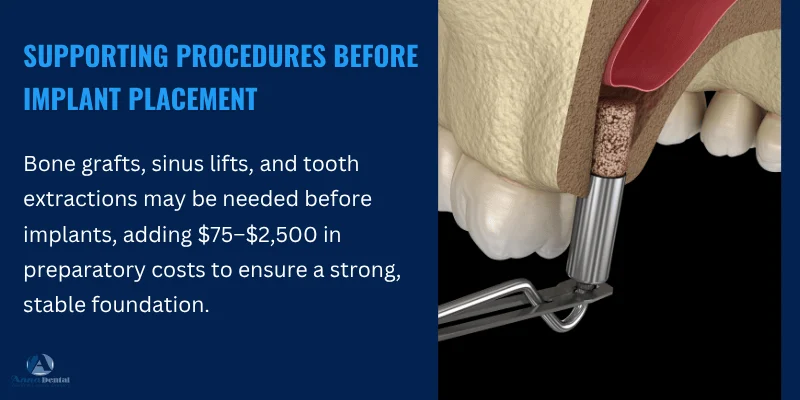
Bone grafting may be necessary if your jawbone isn’t thick or strong enough to support an implant. This procedure adds bone material to your jaw and typically costs $200 to $1,200 per graft.
You’ll need to wait several months for the graft to heal before implant placement.
A sinus lift is required when your upper jaw near the sinuses lacks sufficient bone height. This procedure raises the sinus floor and adds bone material, costing $1,500 to $2,500 per side.
Tooth extractions add to your upfront costs if you still have damaged teeth that need removal. Simple extractions cost $75 to $300 per tooth, while surgical extractions run $150 to $650.
These preparatory treatments increase your initial investment but ensure your implants have the best chance of long-term success.
Comparing Tooth Replacement Options and Long-Term Value
When you’re missing teeth, you have several tooth replacement options to choose from, each with different costs, lifespans, and daily comfort levels.
Understanding how dental implants stack up against dentures, dental bridges, and hybrid solutions helps you see the true value beyond just the initial price.
Dental Implants vs Dentures: Comfort, Stability, and Costs
Removable dentures offer the lowest upfront cost for tooth replacement, but they come with ongoing challenges. They can shift while you eat or speak, which affects your confidence and comfort. You’ll need adjustments and replacements over time as your jawbone changes shape.
Dental implants provide stability that removable dentures can’t match. They’re anchored directly into your jawbone, so they feel and function like your natural teeth. You won’t worry about them slipping during meals or conversations.
The long-term comfort and costs favor implants when you factor in replacements and adjustments. Dentures typically need replacing every 5-8 years, while implants can last decades with proper care.
Your jawbone also continues to shrink with dentures, but implants actually preserve bone density by stimulating it like natural tooth roots.
Dental Implants vs Dental Bridges: Structure and Lifespan
Dental bridges fill gaps by anchoring replacement teeth to your adjacent natural teeth. This means your dentist must reshape the healthy teeth on either side, removing some enamel permanently.
A bridge typically lasts 7-10 years before you need a replacement. The anchoring teeth also face increased stress and potential decay over time.
Implants don’t affect your neighboring teeth at all. Each implant stands independently in your jawbone. This preserves more of your natural tooth structure.
Bridges cost less initially than multiple dental implants. However, when you add up bridge replacements and potential damage to supporting teeth over 20-30 years, implants often prove more economical and preserve better oral health.
Implant-Supported Dentures and All-on-4/All-on-6 Solutions
If you’re missing most or all teeth in an arch, implant-supported dentures combine the benefits of both tooth replacement options. These dentures snap onto dental implants, giving you stability without the bulk of traditional dentures.
All-on-4 and all-on-6 solutions use four or six strategically placed implants to support a full arch of replacement teeth. You get a fixed, non-removable solution that restores your entire smile in one procedure.
These hybrid options cost more than traditional dentures but significantly less than replacing every tooth with individual implants. You can often get same-day temporary teeth, so you’re never without a smile.
The implants still prevent bone loss and provide the chewing power you’ve been missing.
Take the guesswork out of dental implant costs. Visit our Anna, TX dental office to learn your treatment options and financing plans.
Key Factors Influencing Implant Costs
Several elements determine what you’ll pay for dental implants, from the number of teeth you need to replace to where you live. Understanding these factors helps you plan your budget and find ways to manage the expense.
Number of Implants and Complexity of Treatment
The number of implants you need directly affects your total cost. A single tooth replacement typically costs between $3,000 and $6,000, which includes the implant post, abutment, and crown.
If you need multiple implants, the costs add up quickly. However, you might benefit from bundled pricing or more efficient treatment planning.
For example, an “All-on-4” system can replace a full arch of teeth using just four strategically placed implants, which costs less than placing individual implants for each missing tooth.
Your specific dental situation also matters. If you need extra procedures like bone grafting or a sinus lift, expect to pay an additional $600 to $2,000 per site.
These preparatory treatments are sometimes necessary when your jawbone lacks the height or thickness to support an implant properly.
Full-mouth reconstructions represent the most complex cases, with costs ranging from $40,000 to $100,000 depending on the complexity of your procedure and how much preparatory work you need.
Geographic Location and Provider Experience
Where you live significantly impacts your implant costs. Dental practices in major cities and areas with higher living costs typically charge more than those in smaller towns or rural areas.
Your provider’s experience level also affects pricing. Specialists like oral surgeons, periodontists, and implantologists with advanced training often charge premium rates.
Their expertise comes from years of focused education and a track record of successful outcomes.
General dentists with less specialized implant experience may offer lower fees. You’ll need to weigh the cost savings against your comfort level with the provider’s expertise, especially for complex cases.
Material Choices and Technology Used
The materials used in your implants play a major role in pricing. Titanium implants are the most common choice, costing between $3,000 and $5,000 per tooth. They’re durable and have an excellent track record for fusing with bone.
Zirconia implants offer a metal-free alternative with better aesthetics, but they cost more—typically $4,000 to $6,000 per tooth. These are popular among patients who prefer a ceramic option or have metal sensitivities.
Advanced technology like 3D imaging, computer-guided surgery, and digital crown design improves accuracy and outcomes.
These tools require significant investment from dental offices, which can increase your costs. However, they often lead to better results and faster healing times.
Insurance Coverage and Financing Options
Most dental insurance plans don’t cover the full cost of implants, though some help pay for related services like crowns or X-rays. Review your policy carefully to understand what’s included.
Many dental offices offer payment plans that let you spread costs over time. CareCredit and similar healthcare financing options provide extended payment terms, sometimes with promotional interest-free periods if you pay within a specific timeframe.
Some practices offer in-house financing with flexible terms tailored to your budget. Ask about all available options during your consultation to find a payment approach that works for you.
Benefits That Make Dental Implants a Worthy Investment
Dental implants provide permanent tooth replacement that goes beyond just filling gaps in your smile. They protect your jawbone, improve how you eat and speak, and require less maintenance than other tooth replacement options.
Oral Health Benefits and Jawbone Preservation
When you lose a tooth, your jawbone starts to break down in that area because it no longer gets stimulation from the tooth root. Dental implants halt this process and maintain your facial structure over time.
The titanium post acts like a natural tooth root and keeps your jawbone healthy and strong.
This jawbone preservation protects your remaining natural teeth too. When bone loss occurs, nearby teeth can shift or become loose. Implants prevent this domino effect and help maintain proper tooth alignment.
Your oral hygiene routine stays simple with implants. You brush and floss them just like natural teeth, unlike dentures that need special cleaning solutions or adhesives.
The implant doesn’t affect neighboring teeth either, which means you can keep those teeth completely intact during the procedure.
Ready to restore your smile with a long-term solution? Book your dental implant evaluation in Anna, TX today.
Quality of Life: Chewing Function and Comfort
Your chewing function returns to near-normal levels with dental implants. You can bite into apples, eat corn on the cob, and enjoy steak without worry. Implants offer unmatched stability that dentures and bridges simply can’t match.
The improved comfort you’ll experience is significant. Implants don’t slip or move around in your mouth like dentures can. You won’t deal with sore spots from rubbing or the embarrassment of your teeth clicking while you talk.
Speaking becomes easier and more natural too. Dentures can affect your speech and make certain sounds difficult to pronounce. Implants stay firmly in place, so your speech patterns remain clear and confident.
Natural-Looking Smile and Restored Confidence
Dental implants closely replicate the look and feel of a natural tooth when covered with a crown. The custom-made crown matches your other teeth in color, shape, and size. Most people won’t be able to tell which teeth are implants and which are natural.
Your restored confidence extends beyond just appearance. You can smile, laugh, and talk without worrying about gaps or loose dentures. This confidence boost affects your social life, professional interactions, and overall mental well-being.
The natural-looking smile you gain doesn’t fade over time either. Implants maintain their appearance for decades with proper care, unlike dentures that may need frequent adjustments or replacements.
Reduced Long-Term Maintenance Needs
Implants require minimal ongoing maintenance compared to other options. Bridges typically last 5-15 years before needing replacement, while dentures need relining every few years. Quality implants can last 25 years or longer with good oral hygiene.
You won’t need special products or tools beyond regular brushing and flossing. There are no adhesives to buy, no special cleaning tablets, and no overnight soaking required. Your dental checkups remain the same as they would be with natural teeth.
The durability of implants means fewer dental visits for repairs or adjustments. While the initial investment is higher, you save money over time by avoiding replacement costs and recurring maintenance expenses that come with other tooth replacement methods.
Risks, Limitations, and How to Maximize Implant Success
While dental implants have success rates between 95-97%, understanding potential complications and proper care habits can help you protect your investment.
Your lifestyle choices and health conditions play a big role in whether your implants will last for decades.
Potential Complications and Implant Failure
Peri-implantitis occurs in 10-20% of long-term cases and represents the most common serious complication. This inflammatory condition affects the tissues around your implant and leads to bone loss. It happens when bacteria build up around the implant site.
Osseointegration failure affects 1-2% of cases. This means the titanium post doesn’t properly fuse with your jawbone. Smoking triples your risk of implant failure because it reduces blood flow and delays healing.
Other risks include damage to nearby nerves or the maxillary sinus during surgery. Age matters too. Study shows that Patients older than 60 years face twice the risk of adverse outcomes compared to younger patients.
Certain health conditions increase your risk:
- Diabetes – Uncontrolled blood sugar affects bone healing
- Osteoporosis – Reduced bone density weakens implant stability
- Radiation therapy – Success rates drop to 70% in irradiated bone
- Bisphosphonate medications – Interfere with bone turnover around implants
Long-Term Care and Maintenance

Your oral hygiene habits directly impact how long your implants last. Bacterial plaque buildup leads to the same problems that affect natural teeth, as well as peri-implantitis.
Use interproximal brushes that can reach 3mm into the space around your implant. Regular brushing and flossing aren’t optional. They’re essential for preventing infection and bone loss.
You’ll need maintenance visits every 12-18 months. Your dentist will check for plaque, calculus, and signs of loosening. They’ll also take X-rays to monitor bone levels around the implant.
Avoid smoking completely. Research shows that smoking residues like carbon monoxide and cyanide delay wound healing and inhibit bone cell growth. Smokers experience significantly more bone loss around implants than non-smokers.
If you have bruxism (teeth grinding), you’ll need a night guard. Excessive force on implants can cause micro-movements that prevent proper healing.
Who Is a Good Candidate for Dental Implants?
You need adequate jawbone density and height to support an implant. Your dentist will evaluate this through X-rays or CT scans before recommending treatment.
Good candidates have:
- Healthy gums without active periodontal disease
- Sufficient bone volume or willingness to undergo bone grafting
- Good overall health and controlled chronic conditions
- Commitment to excellent oral hygiene
- Non-smoking status or willingness to quit
You might not be a good candidate if you have uncontrolled diabetes, take certain medications like bisphosphonates, or have had recent radiation therapy to your jaw.
Your immune system status also matters. Patients with immune deficiencies face higher infection risks.
Age considerations vary. Implants work well for older adults, though healing takes longer. For younger patients, you should wait until jaw growth is complete. This typically means age 15 for girls and 17 for boys.
Understanding these factors helps you improve long-term stability and avoid complications. Talk honestly with your dentist about your health history and habits before moving forward.
Discover the true value of dental implants. Contact our Anna, TX dental team for a complete cost analysis and treatment plan.
Frequently Asked Questions
Many people have similar questions when thinking about dental implants. Understanding the full picture helps you make the best choice for your smile and budget.
What should I consider before getting dental implants?
You need to think about your overall oral health first. Your jawbone must be strong enough to support the implant, and your gums should be healthy without active disease.
Some people need extra procedures before getting implants. Bone grafting may be necessary if your jawbone has deteriorated from missing teeth.
Your dentist will also review your medical history since certain conditions like uncontrolled diabetes can affect healing.
Think about your commitment to good oral care. Implants need regular brushing, flossing, and dental checkups to last as long as possible.
How does the 3/2 rule apply to the dental implant process?
The 3/2 rule is a guideline dentists use to check if you have enough bone for an implant. Your jawbone needs to be at least 3mm wider than the implant on each side, which means 2mm of bone on the outer side and 1mm on the inner side.
This rule helps prevent complications during and after surgery. If you don’t meet these measurements, your dentist might suggest bone grafting to build up the area first.
The rule keeps your implant stable and protects nearby teeth and nerves. Your dentist will take detailed images to measure your bone before starting treatment.
What are the long-term benefits of choosing dental implants over other alternatives?
Dental implants can last 20 years or more, and many last a lifetime with proper care. Dentures and bridges typically need replacement every 5 to 10 years.
Implants prevent bone loss in your jaw. When you lose a tooth, the bone underneath starts to break down without the root to keep it stimulated. Implants act as artificial roots that preserve your jawbone and facial structure.
You get better function with implants than other options. They don’t slip or move when you eat or talk like dentures can. You can bite with almost the same force as natural teeth.
Can you explain what I might not know yet but should consider before opting for dental implants?
The process takes several months from start to finish. After placing the titanium post, you need 3 to 6 months for it to fuse with your jawbone before attaching the final crown.
You might need temporary tooth replacements during healing. This keeps your smile looking normal while waiting for the implant to integrate with your bone.
Not all dentists perform implant surgery. You may need to see a specialist like an oral surgeon or periodontist for the surgical part. Your regular dentist can then place the crown on top.
Smoking significantly increases the risk of implant failure. The chemicals in cigarettes slow healing and prevent proper bone integration with the implant.
What’s the estimated total cost for a full set of dental implants?
A full set of dental implants for one arch typically costs between $20,000 and $45,000. This wide range depends on your location, the dentist’s experience, and which technique they use.
The All-on-4 method costs less than placing individual implants for each tooth. This approach uses four implants to support a full arch of replacement teeth.
Your total price includes the surgical procedure, the implants themselves, and the prosthetic teeth. Additional procedures like bone grafting or extractions add to the final cost.
How do dental implants compare financially to other tooth replacement options in the long run?
A single dental implant costs more upfront than a bridge or denture. But bridges require filing down healthy teeth next to the gap, which can lead to problems later.
Dentures need adjustments, relines, and eventual replacement every few years. These ongoing costs add up over time and can match or exceed the one-time implant investment.
Implants don’t damage surrounding teeth like bridges do. You won’t face the cost of treating those adjacent teeth if they develop issues from supporting a bridge.
The cost of replacing a single tooth with an implant is almost the same as a fixed bridge over the long term. When you factor in the lifespan difference, implants often become the more economical choice.

