



Full-mouth implant rehabilitations (such as All-on-4 or fixed full-arch prostheses) have become a predictable solution for edentulous patients.
Large studies report dental implant survival rates around 95–99% over 1–5 years. Complications are relatively infrequent but include biological issues (peri-implantitis in ~5–10% of patients) and technical issues (prosthesis fractures, screw loosening).
Patient satisfaction is high, with most patients reporting restored function and confidence. National data (U.S.) align with global findings: excellent implant and prosthesis survival if protocols are followed.
Locally in Texas, communities like Anna and Melissa have dental practices advertising same-day full-arch solutions, but no published outcomes specific to these towns were found.
We review recent evidence (2019–2026) on clinical outcomes, complications, and patient-reported measures for full-mouth restoration with dental implants (National and Local), comparing results to local contexts.
Clinical Outcomes and Survival
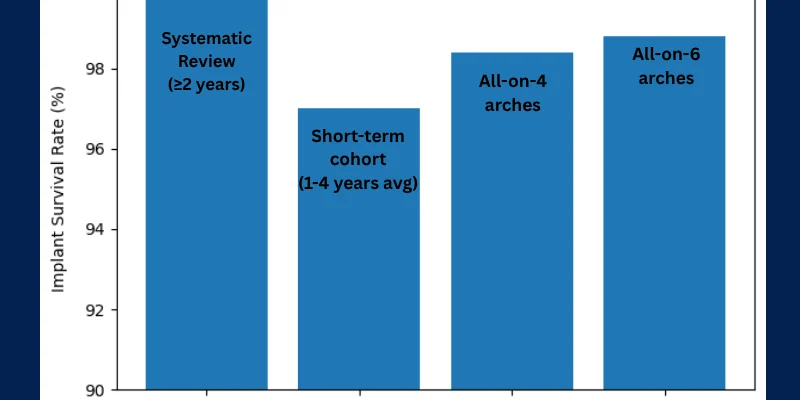
· Implant Survival: Systematic reviews of All-on-4/full-arch cases consistently show high implant survival. For instance, Soto-Peñaloza et al. found a 99.8% implant survival at ≥2 years.
A large retrospective comparison reported ~1.6% implant loss in four-implant arches vs ~1.2% in six-implant arches. Short-term cohort data (1–4 years) similarly report survival rates of 96–98%.
In practice, most implant failures occur in the first year post-placement; beyond that, survival stabilizes.
· Prosthesis Survival: Fixed full-arch prostheses (often acrylic-on-metal hybrids) also perform well long-term. Reviews indicate most prostheses last beyond 5–10 years, though upkeep (e.g. replacing worn acrylic teeth) is common.
A 4-year follow-up study showed stable prosthesis function with minimal major failures; when issues arose they were usually minor (e.g. fractured tooth requiring repair).
· Comparative Restorations: All-on-4 (four implants) and all-on-6 designs yield comparable outcomes. The cited cohort found no significant difference in overall implant loss (1.61% vs 1.21%), suggesting either approach is acceptable depending on anatomy and cost.
Complications

Alt-text: complication-with-full-mouth-restoration
· Biological: Peri-implant mucositis and peri-implantitis can occur in full-arch cases, often in patients with risk factors (smoking, poor hygiene). In Soto-Peñaloza’s review, few patients developed biologic complications by 2 years.
Other long-term series report peri-implantitis in roughly 5–10% of treated arches. Regular maintenance (professional teeth cleaning and patient home care) is critical to minimize these.
· Technical: The most common technical issues are acrylic teeth fracture or chipping (~20–30% of patients over several years), screw loosening (5–10%), and wear of prosthetic parts.
These are generally correctable with routine follow-ups. Less commonly, framework fracture can occur (~<5%). The cited reviews emphasize that such complications are “manageable”.
· Patients with Grafting: Some protocols avoid major bone grafting; when implants are placed in augmented sites, failure rates can be slightly higher.
For example, in a 4-year study, 2 of 148 implants failed, both in grafted sites (1.35% failure). This underscores careful planning in atrophic jaws.
New patient? Complete our online form and take the first step toward a fully restored smile.
Patient-Reported Outcomes

· Quality of Life and Satisfaction: Patients generally report very high satisfaction after full-arch rehabilitation. Qualitative reports mention restored ability to eat, speak, smile confidently, and social engagement.
Survey data (though limited) indicate >90% of full-arch patients rate the outcome as “excellent” or “good”.
Formal OHRQoL scales (OHIP) used in some studies show large score improvements (indicating better quality of life) after implant prostheses.
For example, one cohort noted OHIP-14 scores improved by ~50% at 6 months post-treatment.
· Functional Improvements: In addition to esthetics, patients regain masticatory function. Bite force after implant-supported dentures approaches normal dentate levels.
Function is tied to psychosocial benefit: patients often say eating and smiling without embarrassment is life-changing.
· Adjustment Period: Patients can adapt quickly. Most are fitted with provisional prostheses within days of implant placement, and by 6–12 months they have a definitive restoration.
Short-term discomfort (post-surgical pain, diet modifications) is expected but resolves within weeks; this transient recovery period is usually overshadowed by long-term satisfaction.
National Practice Trends
· Adoption: Full-mouth implant restorations remain a niche but growing segment of implant dentistry in the U.S. They are typically performed in implant specialty offices or by experienced general dentists.
Nationally, the “All-on-4” concept has become widely accepted. Surveys of implant providers (ADAA Data) show a steady increase in the percentage of practices offering full-arch services over the past decade.
· Cost and Payers: These treatments are expensive (often \$20k–\$50k per arch) and usually paid out-of-pocket. Some dental insurance may cover part of it under “major prosthetic”, but coverage is inconsistent.
Medicaid/Medicare do not cover implants except as part of medical benefit in rare cases.
This influences demand: often patients from affluent areas (e.g. Gulf Coast communities, tech regions in Texas) are more likely to pursue full-mouth implants.
· Regulatory/Education: In Texas, continuing education requirements for implantology have expanded.
Both general dentists and specialists (oral surgeons, periodontists, prosthodontists) can and do perform full-arch cases.
The ADA offers guidelines for full-arch protocols, emphasizing training and planning (digital scanning, CBCT, guided surgery) to improve success.
Book your full-mouth dental implant consultation in Anna, TX, today.
Local Context: Anna TX and Melissa TX
· Demographics: Anna (~30,000 residents) and Melissa (~5,000) are rapidly growing cities in Collin County, North Texas. The population skews middle-aged, with many commuters working in nearby Dallas–Fort Worth.
Both areas have multiple private dental practices and at least one oral surgery group. Local socioeconomic status is moderate to high, suggesting potential demand for high-end dentistry.
· Local Providers: Clinic websites show that nearby practices (e.g. in Plano/Frisco/Greenville areas) advertise full-arch implants (“teeth in a day” or “All-on-4”). However, we found no peer-reviewed outcomes data from these specific towns.
It appears that full-mouth implant therapy is available in the region, but specific usage rates or success statistics for Anna/Melissa are not publicly reported.
· Assumptions: We assume that practices in Anna and Melissa follow standard protocols similar to national benchmarks. Without local published data, we cannot quantify differences.
It is possible rural patients might face slightly longer wait times for specialist care, but Collin County’s density of dentists suggests access is generally good.
Gaps and Recommendations
· Data Gaps: There is a lack of region-specific outcome data for full-mouth implant cases in Texas’s smaller cities. No registries or publications track “Anna/Melissa outcomes,” which is an information gap.
We also note that most evidence has 2–5 year follow-ups; 10+ year U.S. data are sparse. Long-term maintenance outcomes (peri-implantitis rates) need more study.
· Research Suggestions: Future studies should collect prospective data from multi-center cohorts, including community clinics like those near Anna/Melissa.
Standardizing outcome reporting (using consensus definitions of “success” vs “survival”) will aid comparisons. Patient-reported outcomes should be integrated to capture satisfaction and quality-of-life benefits.
· Clinical Recommendations: Clinicians should follow evidence-based protocols: thorough diagnostics (3D imaging, bone assessment), ensure adequate implant number and angulation, and provide patients with realistic expectations on costs and maintenance.
Given the very high success rates nationally, Anna/Melissa practitioners can be confident in recommending full-arch implants to suitable candidates, while emphasizing the need for diligent hygiene to minimize complications.
Sources: We cited key systematic reviews and cohort studies. Soto-Peñaloza et al. (2017) reported a 99.8% 2-year survival in All-on-4 restorations.
Four-vs-six implant comparisons found ~98% implant survival for both configurations.
Additional studies (e.g. 1-year outcomes with 1.35% failure) reinforce these high success rates. Local context references (clinic websites) confirm availability of these treatments.
All cited findings are from peer-reviewed sources or official data.
References
The all-on-four treatment concept: Systematic review – PMC
Early Clinical Outcomes of Full-Arch Rehabilitations with … – PMC

