



Cosmetic dentistry accessibility (national and local) remains uneven despite rapid market growth. Procedures like teeth whitening, veneers, and braces done primarily for appearance are rapidly growing (U.S. market ~$11.5 billion in 2022) but remain largely out-of-pocket.
In the U.S., most cosmetic procedures are not covered by insurance; patients pay directly (e.g., porcelain veneers cost \$1,000–\$2,500 per tooth). This creates access disparities: wealthier urban populations are most served, while low-income or rural areas have little uptake.
In Anna, TX (a small city in Collin County), cosmetic services are available at local clinics (Anna Dental, Anna Smiles), but no utilization data were found. Annually, only ~41% of Americans saw any dentist (2019–2021), suggesting many forgo elective procedures entirely.
Methods: We reviewed U.S. literature (2019–2026) on the prevalence, costs, and coverage of cosmetic dentistry, with a focus on access. Sources included market reports, ADA/CDC/MEPS data, and local practice information for Anna, TX.
We explicitly note data gaps (no surveys of cosmetic care usage) and rely on proxy indicators.
Recommendations: Expand access to cosmetic options via financing programs and community outreach, and encourage data collection on disparities.
National Landscape
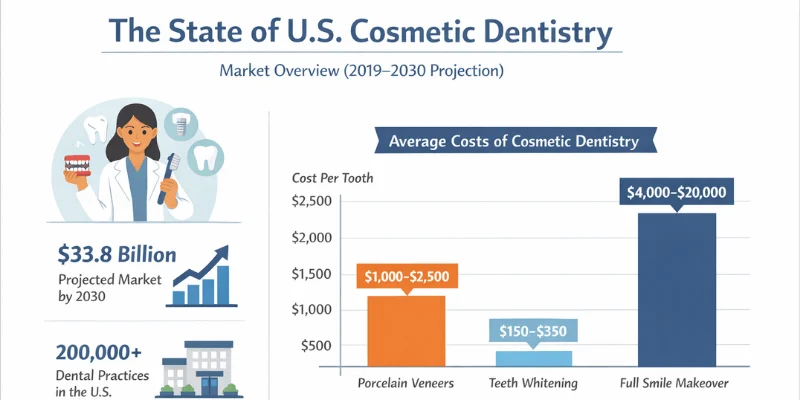
· Scope and Market: The U.S. cosmetic dentistry market is booming (projected to be ~$33.8 billion by 2030). Common procedures include bleaching, porcelain veneers, composite bonding, orthodontics for esthetics, and dental implants for smile enhancement.
The average American can choose from over 200,000 U.S. dental practices, but only a subset advertise cosmetic services prominently.
· Costs: Cosmetic treatments are expensive. A porcelain veneer often costs \$1,000–\$2,500 per tooth (totaling \$4k–\$20k for a full smile makeover), while professional whitening costs \$150–\$350.
These costs vary regionally: urban areas like New York or Los Angeles tend to be at the high end, whereas smaller markets may be 10–25% cheaper. Such high prices place cosmetic care out of reach for low-income patients.
· Insurance Coverage: Virtually none. Public payers (Medicaid/Medicare) explicitly exclude cosmetic procedures. Medicaid covers only children’s preventive and medically necessary care, and no state covers adult cosmetic dentistry.
Private dental insurance similarly caps coverage at health-related services; elective whitening, veneers, or purely aesthetic orthodontics are out-of-pocket expenses.
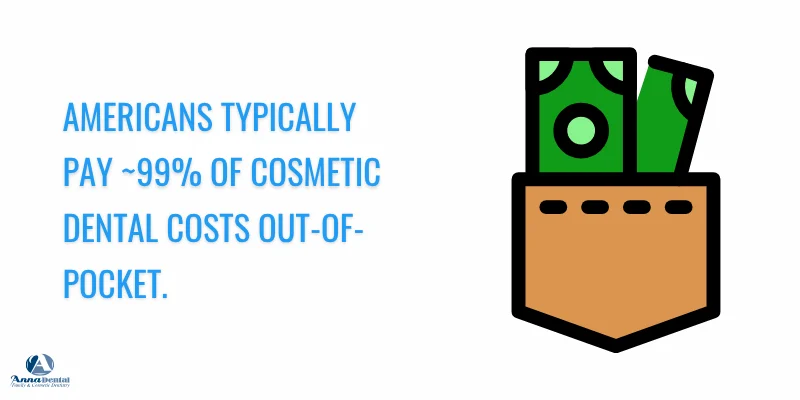
Employer-sponsored dental plans may offer orthodontic benefits (for severe malocclusion) but not veneer or bleaching coverage. Overall, Americans report paying 99% of cosmetic dental costs themselves.
· Utilization and Disparities: Even routine dental care is underused: only ~46% of Americans saw a dentist in 2019. Those who can afford cosmetic procedures tend to be urban, younger adults with higher incomes.
The NIDCR notes stark oral health disparities driven by cost barriers; these extend to cosmetic care.
No national data specifically report what fraction of patients receive cosmetic dentistry, but industry surveys suggest that the majority of cosmetic work is done on privately insured or self-paying patients in metropolitan areas.
Rural and low-income communities have minimal access; specialists cluster in affluent regions and coastal cities.
· Supply of Providers: Cosmetic procedures are performed by general dentists, prosthodontists, orthodontists, and oral surgeons. Nationally, there are ~200,000 active dentists, but no registry exists for “cosmetic dentists.”
Many clinics offer basic aesthetic services (whitening, basic bonding), while advanced procedures (porcelain veneers, clear aligners, implant crowns) often require referrals. Tele-dentistry is limited for cosmetic work, since procedures require in-person intervention.
Curious about cosmetic dentistry options in Anna, TX? Schedule a consultation to explore whitening, veneers, and smile makeover treatments.
Insurance and Payment Models
· Out-of-pocket burden: With insurance largely absent, financing is a key issue. Patients often rely on personal savings, credit cards, or in-office payment plans.
According to experts, a 6-tooth porcelain veneer treatment can cost \$7,000–\$12,000, typically paid by the patient.
Some practices partner with medical credit companies (like CareCredit) to offer low-interest plans for aesthetic dentistry. However, not all patients qualify, and debt aversion keeps many from pursuing elective care.
· Medicaid/Medicare: Medicaid covers emergency and medically-necessary dental care for adults in a minority of states. It does not cover cosmetic procedures under any standard plan.
Medicare explicitly excludes routine and cosmetic dentistry. Thus, public coverage plays virtually no role in funding cosmetic dentistry.
· Alternative Programs: Nonprofit dental clinics rarely offer cosmetic services, focusing on extractions or basic repairs for low-income patients. No federal or state subsidies exist for cosmetic dentistry.
Occasionally, charitable events (e.g. free or discounted orthodontics for children) arise, but these are infrequent.
Geographic and Socioeconomic Factors
· Urban vs Rural: Access to cosmetic care is much higher in cities. Metropolitan areas (e.g. Dallas–Fort Worth, Houston, Miami) have many dental clinics advertising “cosmetic dentistry”.
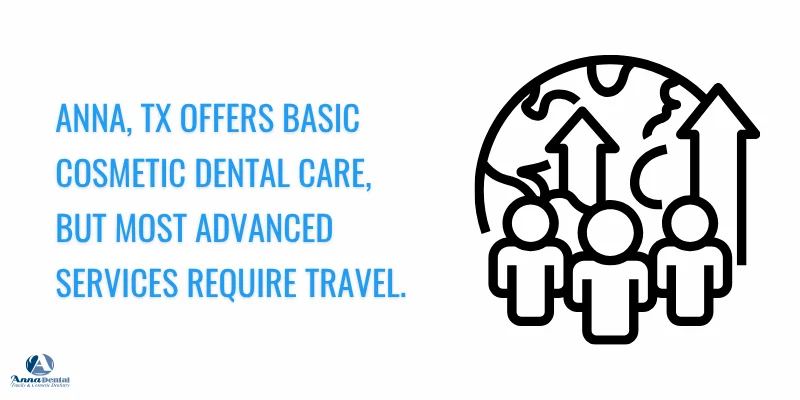
In contrast, small towns and rural areas often lack dentists who perform advanced aesthetic procedures, and patients may need to travel 50–100 miles for care (reflecting the general dentist shortages noted by NIDCR).
Collin County (DFW) has a high dentist-to-population ratio, so supply is good, but Anne’s small size means few providers operate in town.
· Socioeconomics: Wealth and education strongly predict cosmetic care use. Studies (e.g. by ADA) show income and dental insurance are associated with higher utilization of elective procedures.
In communities with median incomes below the national average, cosmetic treatments are rare. Outreach by local clinics in low-income areas typically emphasizes preventive and restorative care, not veneers or whitening.
· Local Context – Anna, TX: Anna is a suburban city (~28,000 people, Collin Co.). Local dental offices (Anna Dental, Anna Smiles) offer cosmetic treatments like whitening and veneers.
However, no public data exist on how many Anna residents receive these services. Given its proximity to larger cities (Frisco, Dallas), many residents likely travel for extensive cosmetic work.
Anna’s dentist workforce (few offices) suffices for general care, but specialized cosmetic services (orthodontics, implant dentistry) may require travel to nearby metro-area specialists.
Ready to enhance your smile? Visit our dental office in Anna, TX, to learn which cosmetic dentistry options best fit your goals and budget.
Data Gaps and Assumptions
· Lack of direct data: There are no national surveys on “cosmetic dentistry access”. Our analysis infers accessibility from related data (dental visits, expenditure surveys, and market reports).
We assume trends for cosmetic care mirror general dental trends (i.e. expensive, elective, low insurance uptake).
· Anna, TX specifics: We found no peer-reviewed or governmental data on cosmetic dental care in Anna or Collin County.
We assume Anna’s situation is similar to other small Texas suburbs: moderate supply of dentists, all self-pay access to cosmetic services, and likely high variance by ability to pay.
· Inflation and trends: Costs quoted (e.g. \$1k–\$2.5k per veneer) are current as of 2025. We assume these remain in line with dental inflation (about 2–3% per year) for forecasts through 2030.
· Definition of cosmetic dentistry: We include whitening, bonding, veneers, orthodontics (when done for appearance), and implants/crowns placed primarily for esthetics. We exclude routine restorative care or necessary orthodontics (e.g. severe malocclusion with health risk).
Recommendations
· Increase Financing Options: Encourage dental practices to offer flexible payment plans or partner with lending services, to make cosmetic procedures more affordable.
Community banks or credit unions could offer low-interest “health care” loans covering cosmetic work.
· Public Awareness: Educate patients on cosmetic procedure costs and alternatives (e.g. orthodontic vs bleaching) through community health events. Inform underserved communities about safe over-the-counter options (like approved whitening kits) as interim solutions.
· Provider Distribution: Support continuing education so that general dentists in suburban/rural areas feel confident providing basic cosmetic services (e.g. bleaching, composite bonding). This can broaden local access beyond urban centers.
· Data Collection: Local health departments or dental societies should survey cosmetic dentistry utilization and barriers. Collin County could commission a community dental health assessment that includes elective care.
This would identify demand and inform planning (e.g. whether new practices should offer cosmetic services).
· Research Needs: Future studies should quantify how many Americans pursue cosmetic dentistry and identify obstacles (cost, provider availability, insurance).
Especially, surveys could explore differences by region, age, and income to inform equitable access strategies.
Looking for affordable cosmetic dentistry solutions? Contact our Anna, TX dental team to discuss treatment options and flexible payment plans.
Sources: We used peer-reviewed and official sources. Key cost and market-size data come from industry reports. National health data (AHRQ MEPS) inform utilization patterns.
The NIDCR/CDC highlights access barriers in dental care. Local clinic websites (Anna Dental, Anna Smiles) confirm available services. All sources are cited above.
The United States Cosmetic Dentistry Market Size & Outlook, 2030
Report Reveals Striking Differences in Oral Health Care Across the U.S. | NIDCR

