



Many people with obstructive sleep apnea struggle to use a CPAP machine every night. The mask can feel tight, the air pressure can be hard to get used to, and the noise can keep you or your partner awake.
If you have CPAP intolerance, oral appliances may provide a more comfortable alternative to discuss with your care team.
You should know that untreated sleep apnea can affect your health and your quality of life. It can leave you feeling tired, foggy, and worn out during the day.
The good news is that CPAP is not the only option, and exploring the right sleep apnea treatment can help you find an approach that better fits your needs.
This post will help you understand everything about dental sleep appliances for CPAP intolerance work and who might be a good fit for one.
You will also learn how it compares to CPAP and what to expect if you decide to try it.
Key Takeaways
- CPAP can be uncomfortable for some people, which makes it hard to use every night.
- A dental sleep appliance works by keeping your airway open in a different way than CPAP.
- Talking with your doctor can help you find the treatment that fits your needs and improves your daily life.
Table of Content
- Why CPAP Can Be Difficult to Use Consistently
- How Dental Sleep Appliances Keep the Airway Open
- Who May Be a Good Candidate for an Oral Appliance
- Comparing CPAP and Oral Appliance Therapy
- Getting Started and Monitoring Your Results
- Frequently Asked Questions
Why CPAP Can Be Difficult to Use Consistently
CPAP therapy works well for many people with sleep apnea, but continuous positive airway pressure machines come with real hurdles that make nightly use hard to stick with.
Mask problems, dry air, and daily upkeep are some of the biggest reasons people look for a backup plan, like a dental sleep appliance.

Mask Fit, Air Leaks, and Claustrophobia
Finding the right CPAP mask fit often takes trial and error. A poor seal can cause mask leaks that wake you up in the middle of the night or blow air into your eyes.
Mask discomfort is one of the top causes of CPAP discomfort that PAP therapy users report. Straps pulled too tight can leave marks on your face, while loose straps let air leaks happen all night long.
Some people also feel claustrophobia when wearing a full-face mask that covers the nose and mouth.
Nasal pillows and a nasal mask are smaller alternatives, but they don’t work well for everyone, especially if you tend toward mouth breathing at night.
Dry Mouth, Nasal Congestion, and Pressure Problems
Dry mouth and nasal congestion are common CPAP side effects. If you breathe through your mouth while using the machine, pressurized air escapes and dries out your throat, making it harder to want to keep using the device.
A heated humidifier attached to your CPAP machine adds humidification to the airflow, which can ease dryness. But not every machine comes with one built in, and getting the settings right takes some adjusting.
Pressure itself can cause trouble too. Some people swallow air while on CPAP, a side effect called aerophagia, which leads to bloating or stomach discomfort.
If a steady, fixed pressure feels too strong, your doctor may suggest switching to an APAP or BiPAP device that adjusts pressure as you breathe.
Travel, Cleaning, and Lifestyle Barriers
CPAP machines are not always easy to travel with. Even a compact option like the ResMed AirMini still needs a power source, tubing, and a mask, which adds bulk to your bag.
Daily upkeep is another common barrier:
- Washing the mask and tubing to prevent mold and bacteria
- Refilling and cleaning the humidifier chamber
- Replacing filters and parts on a regular schedule
- Packing extra supplies for trips away from home
These daily demands add up over time. People prescribed CPAP stop using it or use it inconsistently, often because fitting the routine into work, travel, and family life feels like too much.
How Dental Sleep Appliances Keep the Airway Open
Dental oral appliances work by moving parts of your mouth so air can flow more easily while you sleep.
Most devices shift your jaw or tongue into a new spot, and the fit of your appliance plays a big role in how well it works.
Mandibular Advancement Devices and Jaw Repositioning
If your provider fits you with a mandibular advancement device, you’ll notice it holds your lower jaw slightly forward.
This is called jaw repositioning, and it’s the main way MADs (also known as MAS) treat mild to moderate sleep apnea.
When your jaw moves forward, your tongue moves with it. This opens up space at the back of your throat so air has an easier path.
Most MADs have two parts, one that fits your top teeth and one for your bottom teeth. Screws, hinges, or straps connect the pieces so you can adjust how far forward your jaw sits.
If you have retrognathia, meaning your lower jaw sits farther back than normal, this type of device can help reduce airway obstruction that happens because of your jaw’s natural position.
Tongue-Retaining Devices for Select Patients
You might hear your dentist call these TRDs, or tongue-retaining devices. They work a bit differently than MADs.
Instead of moving your jaw, a TRD uses gentle suction to hold your tongue forward. This keeps your tongue from falling back into your throat, which is a common cause of airway collapse and snoring.
TRDs can be a good option if:
- Your teeth aren’t strong enough to support a MAD
- You want a device but can’t tolerate a jaw-based option
- Your dentist recommends this alternative based on your mouth’s structure
This type of oral appliance therapy isn’t used as often as MADs, but it still gives you a way to manage airway blockage without surgery or a CPAP mask.
Why Custom Appliances Matter
You can find over-the-counter mouthpieces, but a custom oral appliance made by a dentist trained in dental sleep medicine usually works better for you.
That’s because your dentist takes exact measurements of your teeth and jaw.
A custom fit means the device sits comfortably and holds its position all night. Store-bought options often shift out of place, which can reduce how well they open your airway.
Your dentist can also adjust a custom appliance over time. If your first setting doesn’t fully stop your snoring or improve airflow, small changes can make a big difference in comfort and results.
Who May Be a Good Candidate for an Oral Appliance
Whether an oral appliance is right for you depends on your sleep apnea severity, your jaw and teeth health, and how well you handle CPAP.
Your sleep physician and a dental sleep specialist will look at these factors together before recommending this treatment.
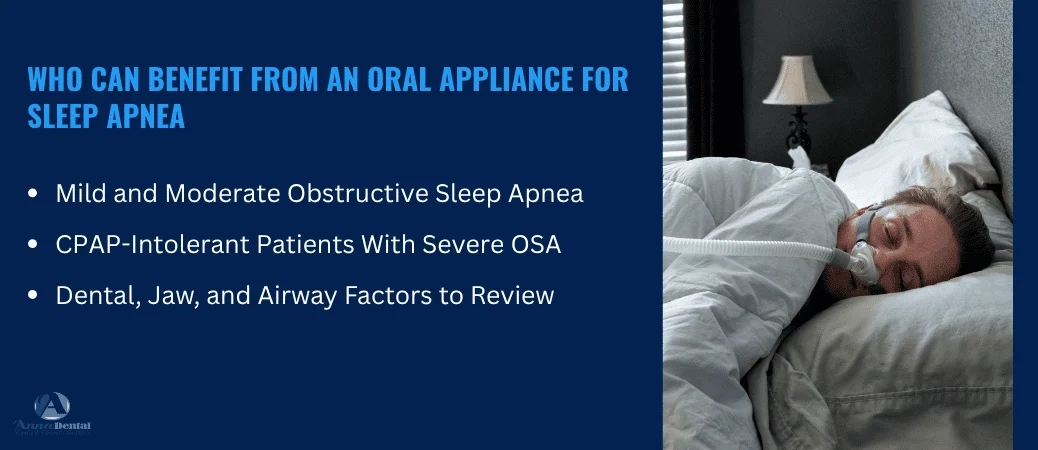
Mild and Moderate Obstructive Sleep Apnea
If your sleep study shows mild-to-moderate sleep apnea, you’re often a strong candidate for an oral appliance. Doctors measure your sleep apnea severity using something called the apnea-hypopnea index, or AHI.
This number counts how many apnea events happen per hour while you sleep.
For moderate OSA, your AHI usually falls between 15 and 30 events per hour. Your sleep study also checks your oxygen desaturation levels, which show how much your blood oxygen drops during these events.
If your numbers land in the mild-to-moderate range, an oral appliance can work as well as CPAP for many people. Your sleep specialist will review your results and help you decide if this option fits your needs.
CPAP-Intolerant Patients With Severe OSA
You might still qualify for an oral appliance even with severe OSA, but only under certain conditions. This usually applies if you’ve tried CPAP and truly can’t tolerate it, despite your care team’s best efforts to help you adjust.
Severe sleep apnea comes with higher risks, so your sleep physician needs to stay closely involved. You’ll likely need more frequent follow-ups to check that the appliance is controlling your symptoms well enough.
Dental, Jaw, and Airway Factors to Review
Your dentist needs to check your teeth, jaw, and airway before fitting you for an oral appliance. You need enough healthy teeth to anchor the device securely in your mouth.
At Anna Dental, Dr. Ryan Sharp and the dental team take a personalized approach to care, considering your individual needs and oral health when developing a treatment plan
Here’s what your dental sleep specialist will evaluate:
- Teeth condition: Missing teeth, dentures, or advanced gum disease can rule out this option
- TMJ health: If you have TMJ disorders, jaw pain, or clicking, moving your jaw forward with an appliance might make this worse
- Bruxism: Teeth grinding can wear down the device faster and may need extra attention
- Jaw and airway structure: Certain physical traits in your mouth or throat can limit how well the appliance works
The Anna Dental team can walk you through these factors during your evaluation and help determine whether an oral appliance fits your needs.

Comparing CPAP and Oral Appliance Therapy
CPAP and oral appliances work in different ways, and each one comes with its own pros and cons.
Looking at how well they work, how comfortable they are, and whether you can combine them can help you find the right fit for your needs.
Effectiveness Versus Nightly Adherence
Continuous positive airway pressure is the gold standard for treating obstructive sleep apnea. It’s the most effective option for keeping your airway open all night long.
But being effective doesn’t matter much if you don’t use the device. This is where oral appliances often win.
People are more likely to wear their oral appliance every night compared to a CPAP mask.
If CPAP intolerance is stopping you from getting real benefits, a device you’ll actually wear may help more than one you keep taking off. Your results depend on how often you use your treatment, not just how well it works on paper.
Comfort, Portability, and Sleep Quality
CPAP therapy involves a mask, tubing, and a machine that needs power each night. This setup can feel bulky if you travel often or share a bed with someone.
Oral appliances are small and don’t need electricity. You can pack one in a bag and use it anywhere.
Comfort makes a big difference in your sleep quality. If a mask feels tight or leaks air, you may wake up more during the night. This can lead to daytime fatigue and daytime sleepiness the next day.
An oral appliance may feel more like wearing a mouthguard, which many people find easier to adjust to over time.
When Combination Therapy May Help
Sometimes, one treatment alone isn’t enough to fully control your symptoms. This is where combination therapy comes in.
You might use an oral appliance along with:
- Positional therapy: Devices or wearable sensors that help you avoid sleeping on your back, since sleep position affects how easily your airway narrows.
- Weight loss: Even a modest weight loss can reduce airway blockages and improve results from oral appliances.
- Lower CPAP pressure: Some people use an oral appliance to reduce the air pressure needed to keep their airway open.
Combination therapy is usually not recommended for central sleep apnea, since this type is caused by signals from your brain rather than airway blockage.
Your doctor can help you decide if mixing treatments makes sense for your case.
Getting Started and Monitoring Your Results
Moving from CPAP to a dental sleep appliance is not something you do on your own. It takes teamwork, a careful fit, and regular check-ins to make sure the device is actually helping you breathe better at night.
Coordinated Care With a Sleep Physician and Dentist

Your first step is talking to your sleep physician about switching or adding an oral appliance. They will look at your sleep study results and decide if this option makes sense for you.
Sometimes an ENT gets involved too, especially if something in your nose or throat is adding to the problem.
Once you get the green light, an experienced dentist takes over the fitting process. This dentist has special training in sleep appliances and works closely with your doctor.
Together, they figure out who decides between CPAP and a dental appliance, based on how severe your apnea is and how your body responds to treatment.
Fitting, Titration, and Dental Monitoring
Getting the appliance right takes a few visits. Your dentist will slowly adjust the device to move your jaw forward bit by bit. This is called titration, and it helps your airway stay open without over-adjusting your jaw all at once.
During this time, it is normal to notice some jaw discomfort, jaw soreness, or mild jaw pain. Tooth tenderness and extra saliva are common too, especially in the first few weeks.
Your dentist checks for tooth movement and bite changes at each visit. This dental monitoring helps catch problems early, before they become bigger issues.
The correct process to switch treatments usually means wearing both CPAP and the appliance for a while.
A follow-up sleep study while using only the appliance confirms it is truly controlling your apnea. Skipping this step is not a good idea.
Follow-Up Testing, Side Effects, and Insurance
Once your appliance is fitted and tested, you are not quite done. Regular dental checkups keep the appliance working properly and help make sure your bite stays stable over time.
Side effects like jaw pain, tooth tenderness, or drooling should ease up after the adjustment period. If they do not, tell your dentist right away.
Some medical plans require prior authorization before they will pay, and others treat the device as durable medical equipment, similar to how they handle a CPAP machine.
It is worth calling your insurance company early to avoid surprise bills.
Staying on top of treatment matters for more than comfort. Untreated sleep apnea raises your risk of high blood pressure, heart disease, and stroke.
Morning headaches are another sign your treatment might need adjusting, so mention them at your next visit.
Frequently Asked Questions
Here are quick answers to common questions about CPAP intolerance and dental sleep appliances, covering costs, effectiveness, and how to know if a switch makes sense for you.
What can I do if I can’t tolerate CPAP therapy?
You have more choices than you might think. Oral appliances, positional therapy, weight loss, and even surgery can all help manage sleep apnea if CPAP isn’t working for you.
Many people struggle with the mask, the noise, or just feeling boxed in at night. If that sounds like you, talk to your doctor about CPAP alternatives that fit your lifestyle better.
You’re not stuck with one option. The goal is finding a treatment you’ll actually use every night, not just one that looks good on paper.
When is a dental sleep appliance is a good alternative to CPAP?
A dental sleep appliance works well if you have mild to moderate sleep apnea. It’s also a solid choice if you’ve tried CPAP and just can’t get comfortable with it.
These devices are custom-fitted by a dentist and move your jaw slightly forward to keep your airway open. You might be a good fit if you have enough healthy teeth and don’t struggle with severe jaw pain or grinding.
Your dentist can work together to figure out if this path makes sense for your specific case.
How effective are oral appliances for treating sleep apnea?
Oral appliances work well for many people, especially those with mild to moderate sleep apnea.
Research shows that mandibular advancement devices can cut sleep apnea severity in 50% of users, and about a third of people see their symptoms go away almost completely.
Compliance rates also matter here. People tend to stick with oral appliances more consistently than CPAP, since they’re easier to wear night after night.
Every case is different, though. Your results depend on things like the severity of your apnea, your jaw structure, and how well the appliance fits.
What are the pros and cons of a mandibular advancement device?
Mandibular advancement devices, or MADs, come with real benefits. They’re small, quiet, and easy to pack for travel. You don’t need electricity to use one, and many people find them far more comfortable than a CPAP mask.
There are downsides too. You might notice extra saliva, a dry mouth, or sore gums when you first start using one. Some people also experience jaw discomfort or changes in their bite over time.
These side effects are usually mild and fade within a few weeks. Regular check-ins with your dentist help catch any issues early.
Can a dental appliance make sleep apnea worse?
For most people, a properly fitted dental appliance improves sleep apnea rather than worsening it. But it’s not the right choice for everyone.
If you have severe sleep apnea, significant tooth loss, or an existing TMJ disorder, a dental appliance might not give you enough relief. In some cases, it could even aggravate jaw pain or teeth grinding.
That is why proper fitting and ongoing follow-up matter. At Anna Dental, we carefully fit and adjust your oral appliance, monitor your teeth and bite, and make sure the device is supporting your treatment goals rather than simply reducing snoring.
How much does a custom oral appliance for sleep apnea cost?
A custom-fitted oral appliance typically costs between $1,500 and $2,500, which includes the device itself along with fitting and follow-up visits. Skipping the custom fitting to save money isn’t a good trade-off.
Over-the-counter “boil and bite” devices are cheaper, but they rarely fit well enough to actually treat sleep apnea.

